South India is famous for its beautiful silk and its unique techniques of making magnificent sarees. The illkal saris of Karnataka, the indigo is used for dyeing purposes. Gadwal and Wanaparti in Andhra Pradesh produce saris of thick cotton with a contrasting silk border and pallu worked in gold.
In Tamil Nadu, the cotton sari patterns closely resemble the silk ones. The important centres are Kanjeevaram, Salem, Pudukottai and Madurai. Coimbatore has its own style of cotton saris which are less expensive and which resemble the Chanderi patterns. Nowadays, cotton saris woven with the traditional silk patterns, called kalakshezra, are widely popular. Kerala has started weaving cotton saris lately. Its specialty isthe karalkudi saris of unbleached cotton with rich broad gold borders and pallus.
Showing posts with label Ethnic Clothing. Show all posts
Sunday, July 17, 2011
Saturday, July 02, 2011
Gypsy Skirt Jupe Cotton Wrap Summer Clothes
Girls' skirt in hand-loom woven cotton fabric is especially suitable for women in late twenties and beyond. Hand-block prints in Indian motifs make them attractive casual apparel. Drawstring at waist adds to their casual look and feel. Urban women in India in the age group twenty five to fifty prefer to wear these skirts in spring and summer. Long cotton skirts have airy feel in summer.
Early Indian literature, speaks of the bhairnivasni, a skirt like garment, which evolved from the antariya, a simple tube shaped garment. This was stitched on one side, gathered and held at the waist by a girdle. Women wore it as a lower garment. It later evolved into a skirt with a drawstring called the ghaghri. The ghaghri was a narrow skirt, made from five and a half meters of fabric, the same length as the original antariya. The skirt in India is known by many different names, depending on the regional style, the most popular, by far, being the ghaghra.It was the flare that made the ghaghra such a sumptuous garment and one so captivating that it was celebrated both in poetry and art. The ghaghra is really a long skirt, which has the construction of a simple gathered skirt or a flared gored skirt. It covers the legs fully or partially, depending on the norms of propriety among different ethnic groups, although a long ghaghra usually relates to more.
Monday, May 02, 2011
Finding the Perfect Father's Day Gift
The perfect gift for father's day should be well thought out, personal and different. Adding an Indian touch to those regular presents will help increase the value of the present and the surprise felt by your father.
The Kurta Pajama is a personal and useful choice. A traditional Indian piece of clothing, the Kurta Pajama is comfortable and can be warn on any occasion. A universally popular choice, it is made in pure cotton to help endure those warn summer days. These Kurta Pajama sets from Rajasthan and Gujarat are not only found in traditional block printing patterns, but also tie and dye, rich embroidery and intricate mirror work.
The short kurtas are similar to the kurta pajama, only with the absence of the pajama and shorter Kurtas. A more casual pick, the Mens short sleeve Casual Cotton Shirt Kurtas, are made for comfort and endurance for the summer heat. A more affordable option, the Short Kurtas, like the Kurta pajama, come in various designs and patterns including tie and dye, block printing, rich Indian embroidery and intricate mirror work.
Cufflinks- The perfect gift for all those workaholic fathers out there. Made out of sterling silver and different gemstones, these Indian handmade novelties are a well thought out and unique gift. This item is definitely going to earn you kids some browny points this year!.
Used for religious and inspirational purposes, sculptures and statues, of Hindu Gods and Goddesses, help bring about peace, serenity and a sense of inspiration and stimulus in the surrounding areas. Carved by some of the finest sculptors of India, most of these styles were introduces in the 10th and 11th century.
Thursday, December 16, 2010
Womens Outerwear Wool Jacket Kashmiri Hand Embroidery
Women's jacket with Kashmir hand embroidery is exceptional, elegant, and extraordinary. It is perfect for woman of elegance and mystery. Embroidered woolen jackets, with an eye catching appeal, are made by the same artisans who are known world over for creating some of the finest shawls.
Tuesday, November 30, 2010
Indian Jamawar Wool Shawls Stoles Wraps
Shawl is one of the most important products woven by the artisans of this region. The jamawar design is a special floral pattern, which resembles the mango fruit. Historically, it was made by hand and some shawls took several years to complete.
The task of creating a jamawar shawl is complicated as the designs on these shawl are realized not by embroidery but by the simultaneous weaving with wool shuttles of different colors. These shuttles known as kaani in the local language gives Jamawar another name kaani shawl. The wool being delicate, it is essential to use hands instead of machine and that requires enormous patience of the weavers among all the other qualities. Due to the enormous effort put in weaving and the amount of time it requires to be completed, the prices of the real Jamawar shawls are very high in the market since the old times. These shawls were so special that they often made the exclusive royal gifts to the foreign guests. They were also in vogue in many parts of Europe mainly as they held close resemblance to the Paisley shawl.
Monday, September 27, 2010
Ladies Fashion Accessory with Tie Dye Prints
The tying of cloth with thread and then dyeing it is the simplest and perhaps the oldest form of creating patterns on a plain piece of cloth.
Tie dye printed cotton Sari is made by the artisans of Rajasthan in north India. These are colorful, yet always light on body. Women wear tie dye print cotton Sari on informal and casual occasions as well as wedding dresses.
Shawls in tye and dye print give earthy and rustic look that many women are very fond of. These shawls go very well with jeans trousers and make great casual dress. The wool fabric is of a coarse kind since they pick up colors during tie dye process better than other fabric.
Scarves in tie dye print serve multiple purposes. It is an important part of the sundresses during summer season in India. It is light in weight and soaks sweat well. Colorful print on these scarves also makes them look very elegant.
Womens Casual fashion dresses shalwar kameez is the preferred dress for Asian women. School going teens to old age women, every one prefers shalwar kameez to any other form of dress. The dress is easy to wear. It covers entire body, looks graceful without ever giving feel of orthodoxy.
This skirt is very ethnic in look. The skirts are made using typical Rajasthani Textiles. The Textile of Rajasthan has a fascinating range of dyed and block printing fabrics. The most commonly used fabric is cotton in which Rajasthani colour-scheme design and technique is used in the skirts.
Friday, September 10, 2010
Scarf Fashions Accessory Wrap Styles
A scarf serves multiple purposes. A scarf can add glamor to a simple dress, touch a warmth on a cold day and protects hair from dust and sun rays in the summer. Whenever you wear a scarf remember that there are many ways to wrap a scarf. Its depend upon you which style suits on you and whatever you like.
Neck Scarf(Muffler) Style:
You can choose this style when you wear a long rectangular scarf. This is very easy and quick style and looks elegant with any type of dress. But basically you can wear it with salwar kameez.
Poncho Style:
This is the another style of wrap a scarf. This is also called poncho style. You can choose this style when you wear a large square scarf. Turn a scarf into a triangle.
Drape around your neck.
Wrap Style:
For this style you have to choose a long rectangular scarf. In this style you wear the scarf around your whole body. This is very simple and quick style. This is also called shawl style or wrap style.
Tuesday, August 24, 2010
How to Wear Indian Sari Traditional Clothing for Women
Women across the globe introducing to you the Ready-to -Wear Indian sari. If you thought you could never wear a sari because you didn't know how to wear, you can now change your mind!
Dress up in this eternal essence of femininity and make heads turn at parties, on the streets and especially at home. Don't miss this wonderful opportunity to look like an Indian beauty without a hassle. The Ready-to-Wear Sari can be worn like any other dress you wear. Just follow the Instructions carefully and there you are looking like a million dollars.
Step 1: Wear your petticoat and blouse and pass the sari around to the front maintain the same height.
Step 2: Hold your sari from the corner keeping the fall of the sari towards the feet.
Step 3: Tuck in the sari into your petticoat, take it around you towards the left and then from behind towards the right, bringing it out with your right hand. Make sure the sari is well tucked in all around the waist. The pleats of the sari should settle in the center of the belly and you can press them with your hands to make sure they are well evened out and settling elegantly at your ankles or below your feet as per your style.
Step 4: Now take the rest of the sari, this is known as the "pallu". Put it over the left shoulder and let it flow. You can pin up the "pallu" at the shoulder so it remains in place or you can simply let it hang over your shoulder like you would with a muffler or a shawl.
The Final Look >>>Look like an Indian beauty queen.
Wednesday, August 04, 2010
Designer Madurai Saree in Cotton Tie n Dye Print Bandani Sari

The nineteenth-century sungudis (no longer made) has simple geometric patterns in different colours (usually red and black). At the opposite end of the social scale are Kalamkari resist-dyed until the end of the nineteenth century. Often known as Kodalikarupur or Karupur saris, after the village of manufacture, they consisted of a fine cotton muslin in which discontinuous supplementary zari patterns were woven in the jamdani technique. The muslins were then resist-painted by hand and dyed in various natural colours, giving a rich but somber variety of red tones to the fabric. In many ways the designs are reminiscent of the hand-drawn nineteenth-century Gujarati saudagiri prints made for the Thai marker. In the early and mid-nineteenth century, "fine cotton chintzes" (Kalamkari saris) were also made in Madurai and Kalahat (north Arcot) as well as Machilipatnam.
Monday, July 05, 2010
Latest Indian Fashion Womens Casual Wear Salwar Kameez
In India, salwar kameez is the most common casual dress for young women. Cotton is the best salwar kameez as casual wear. They are cool, flowing and elegant. Casual salwar kameez are available in designs ranging from ethnic chic to traditional to modern prints, in a wide range of fabrics. Women of all sizes can wear these outfits. These sets are available in various prints, color,designs and styles.
Indian ladies will prefer to wear their traditional cotton salwar kameez at home, the majority of Indian women will go for the cheap cotton salwar kameez. These salwar kameez are also produced in simple designs and low rates for regular wear. Casual salwar kameez are stylish and wonderfully comfortable, ideal for the long hot Indian summers.
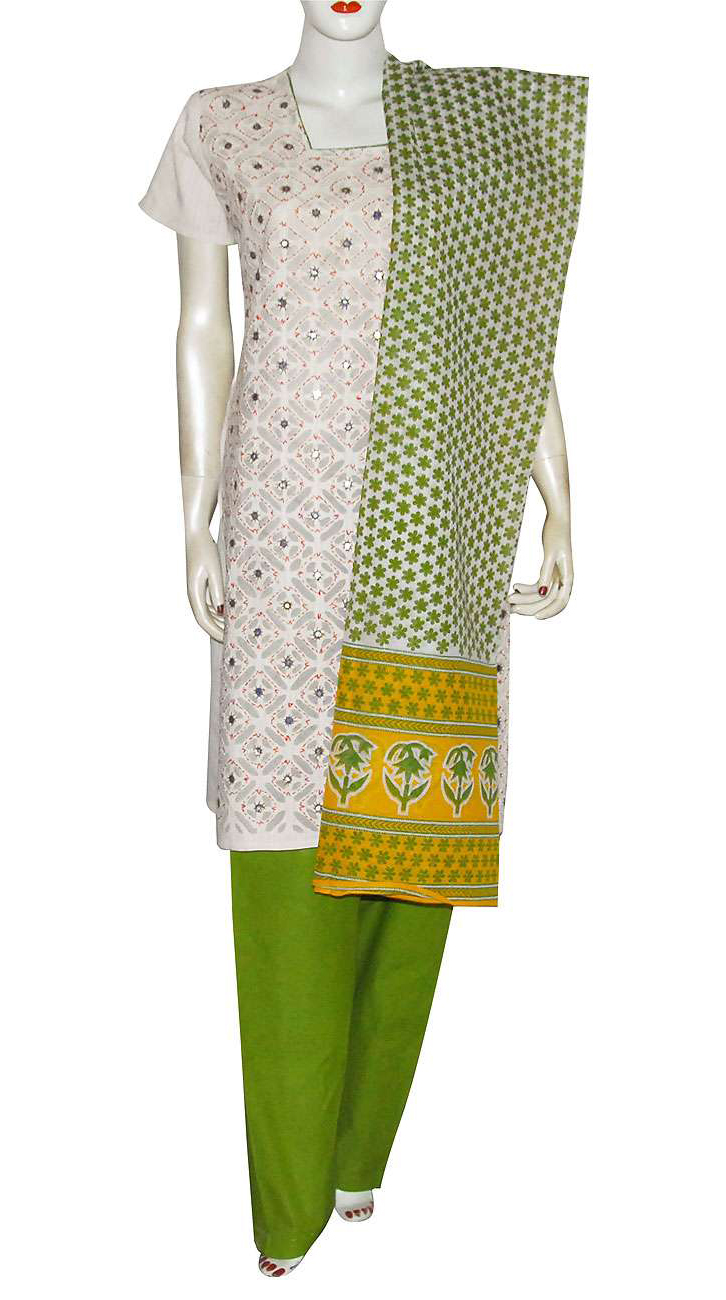
Chikan Embroidered Salwar Kameez- Chikan embroidered salwar kameez is very popular.the embroidery work is embellished with threads.Chikan salwar kameez come in variety of colors, designs and patterns. The look of any fabric is enhanced with chikan hand embroidery on the kurta, bottom of the salwar and the dupatta is also embroidered gorgeously.
Gujarati Embroidery- Gujarati embroidery involves a lot of geometric patterns with use of mirrors and beads. Each state in India has a unique embroidery style and an equally unique set of motifs. Gujarati embroidery is a form of rich indian style embroidery. There is hardly any design or technique that is not included in Indian designs.
Tie and Dye - Bandhej Salwar Kameez in designs & patterns & color combinations.An excellent tie dye print garmets in many colors, sizes and styles.Exquisitely dyed clothing with new designs,colors and patterns.
Kids Salwar Kameez- salwar kameez outfits in all sizes. The same dress can also be made for your teenage daughter or for your kids in soft fabric and unique design.
Friday, May 14, 2010
Kurta Pajama Men's Casual Long Sleeve Comfort Dress
Men casual clothing kurta pajama set is a gift to the Indian traditional wear by the great Mughals. In their custom, both men and women enjoyed kurtas and pajamas cut in long flowing panels. These elaborately embroidered kurtas with real gold and silver threads, weighed between 5 to 10 kilograms. With the change in time and fashion, modifications were made according to the comfort and affordability of people. Now the kurta pajama is more of a mans informal relaxing wear. Though the source of inspiration remains the same old Mughal fashion, many new changes are seen in todays style of Kurta pajamas. Among men, the most commonly worn kurtas are the coarse handloom kurta with high Chinese collar. They are either plain woven or the designs are woven in different colors.
Comfort and easy wearing quality has made the kurta pajama universally popular. They are worn in winters as well as summers. Summer welcomes crisp and light cottons, while winter gives way to all heavy and thick materials. However, the hand-loom kurtas are worn in both summer and winter. The style popular among mens kurtas is the straight cut with side pockets.
The prints commonly seen on this apparel in summers are block print and tie and dye of Rajasthan and Gujarat. These kurta pajama sets from Rajasthan and Gujarat come in not only traditional block printing and tie and dye but also with rich embroidery and glittering mirror work. The chikan hand embroidery of Lucknow is also very popular for its traditional rich look and values. These are usually made in pure cotton as they are worn mainly in summer. The winter Kurtas are in silk, satin, and other thick fabrics.
Sunday, March 21, 2010
Caftan Wear it as Evening Gown and Maternity Clothing
The Caftan is typically a man's garment in its countries of origins. It may be worn over pajama style pants in places like Egypt. The first caftans were generally quite simple, but designs, fabrics and prints became more complex over time. Elaborately printed and embroidered caftans might also be given as gifts.
The Caftan may also be worn by women in the US, where it is typically called a muumuu. It is again, usually not belted and may come in a variety of prints. The caftan in the US may be cotton, cotton/polyester, or cotton gauze. It is usually worn as a housedress, an evening gown, or a maternity dress and some embroidered caftans from India can be used as a party and cocktail dress and can be extremely comfortable.
Caftan or Kaftan is a new addition to Indian women’s wardrobe. The dress judgment has been borrowed from Middle East. However, a dress has also left through certain modifications to adjust to fondness of Indian women. There is a some-more elaborate tailoring, giving it sleeves, and bust and waist turn fittings. This creates Indian caftans fit to be ragged as an dusk gown, or as a celebration dress. These caftans are singular as they are domestic by some of a finest weaving artisans of Gujarat. The elaboration and copy skills of Gujarati artisans are reputable worldwide. The fabric is printed by block copy or by tie and dye. The artisans make a dress visually even some-more appealing by colourful patchwork and appliqué work. All of caftans come in string fabric creation the dress intensely breathable. When we wear Indian caftans, we feel we are not only wearing a dress; we are wearing a work of art, a dress that has a soul.
Tags:
Caftan,
Ethnic,
Ethnic Clothing,
kaftan
Location:
Mumbai, Maharashtra, India
Thursday, March 04, 2010
Wedding Dresses Sari Traditional Indian Dress Saree
A sari or saree is the traditional female garment in India.A sari is a strip of unstitched cloth,the dazzling fabrics, colors, patterns, and draping styles of the sari- an untailored length of cloth generally measuring 12-27 feet long by 4 feet wide-have long been a source of fascination, that is draped over the body in various styles. The most common style is for the sari to be wrapped around the waist, with one end then draped over the shoulder baring the midriff.
The sari is usually worn over a petticoat (under skirt) with a blouse known as a choli forming the upper garment.These are usually more dressy with a lot of embellishments such as mirrors or embroidery and may be worn on special occasions.Saris of different designs and materials are available in a variety of colours. It is made out of cotton, silk and other synthetic materials.The cost of the saris varies according to the quality. The outer end of the sari or (Pallu) is most attractive especially on silk saris.
'Silk Sari'- Magnificent,very fine silk sarees with new designs, new fashion and colors.Traditional and trendy Benarasi Pure Silk sarees with excellently designed pallus and borders with antique zari work in rich colors.
'Chikan Embroidered Sari'- chikan embroidered sarees in cotton fabric with their fine embroidered patterns. The chikan embroidery on the pallu and border is done with heavy thread for finest quality.
'Cotton Sari'- printed cotton sarees with a perfect style. They are made using superior quality of raw materials. cotton sarees not only reflect the true Indian beauty and cultural heritage but are also decorated all over with new designs.
'Tie Dye Sari'- India has a great variety of Bandhani, tie and dyed fabrics. These are colorful, yet always light on body.Varying in size, style, pattern,and richness with new designs and soft colors.
Friday, December 25, 2009
Wrap Cloth Jacquard Design Jamawar Wool Shawl
Wrap clothes shawls in pure wool with designs of antique paisley are very popular in India, just in the way silk shawls are popular in the west. It may be for the simple reason that they go very well with some Indian dresses like saree and salwar kameez. It may also be because these shawls in earthy shades like maroon, green and sand are preferred colors of many Indians. In recent times Jamawar shawls have been very popular also in the west, gradually replacing silk pashmina.
Sunday, December 20, 2009
Embroidered Shawls Scarves Phulkaris of Punjab
The earliest design on Kashmir seventeenth and eighteenth century shawls was a single flowering plant complete with roots, inspired by English herbals (books with plant illustrations) which reached the Mughal court during the seventeenth century. If the Kashmir shawls were the classical masculine high art of the loom, the phulkaris of Punjab represent the totally feminine art of the home.
Here, we have entered an entirely different ethos; there were no commercial pressures, just an ambience of warmth and family love expresses within the context of the community. Phulkaris were worn by women all over Punjab during marriage festivals and other joyous occasions. They were embroidered by the women for their own use and use of other family members and Phulkaris were never meant for sale but were the tangible tokens of continuity and heritage; they were the space where women got together to create marvels of the embroiderer's art, a play of textures and shimmering hues so fine that today we see them as the "dance of colour and light".
Monday, November 23, 2009
Fashion Poncho Shawl Jacquard Designs
Poncho Shawl in paisley design wool fabric are designed to serve twin purposes - keeping the body warm, and looking elegant. The fabric used is the same that is used for making a very popular shawl in India known as Jamawar. This fabric is 100% wool and has beautiful woven designs (jacquard). The designs have been borrowed from classic paisleys. Thus extensive use is made of designs inspired by leaves, flowers and fruits found in India. Another distinctive aspect of these wool ponchos is that they never give itching sensation to the skin. These wool ponchos are meant to be worn in mildly cold weather. Since these ponchos are light weight, they do not hang heavily on the shoulders. No other dress matches wool ponchos when it comes to experiencing warmth, elegance and comfort all at once.
Saturday, October 31, 2009
Ethnic Zari (Floral) Embroidery of Kashmir India

Kashmir valley, a natural paradise, full of flowers and maple trees, produces the best hand embroidery work. Artisans draw inspirations from the beautiful nature around. The boteh (flower) or ambia (mango) motifs are the most favored one of the Kashmir designers. The colors used are those of the flowers of the valley. An emphasis on pastel and white shades on a white background is always preferred. Fine embroidery work is done in shades discreetly blending with the background shades. Very seldom one finds a combination of more than two embroidery styles on one object. The stitches are so typical of the region that they are frequently termed as the Kashmiri Stitch. Kashmiri embroidery is remarkable for the skilled execution of a single stitch rather than the elaborate quality of the stitch itself. Chain stitch, satin stitch, the slanted darn stitch, stem, herringbone or sometimes the doori or knot stitches are used.
The excellence of the needlework is most remarkable in the creation of a dorukha or a double-sided shawl. In this shawl, there is no right and wrong side. The same design is produced in different colors on both sides. The price of a shawl depends on the amount of embroidery done on it.
Thursday, October 15, 2009
Shalwar Kameez Ladies Embroidered Cotton Garments
Salwar kameez (also spelled shalwar kameez or shalwar qameez) is a traditional dress worn by both women and men in Southern Asia. Salvars or shalvars are loose pajama-like trousers. The legs are wide at the top, and narrow at the bottom. The kameez is a long shirt or tunic. The side seams (known as the chaak) are left open below the waist-line, which gives the wearer greater freedom of movement. It is the most common dress for men in Pakistan and Afghanistan.
Sunday, September 20, 2009
Kurta, Shirt, Tunic Costumes from India
Apart from the sari, ghagra and choli, another very important costume depicted in art is the kurta or the Persian shirt. These kurtas have an opening at the neck and slits on the sides. Some of the women's kurias have slits on the sides and give the impression of a four-pointed hemline. Another style of the Kurta was with a crossover flap and side openings, somewhat similar to the angarhha. The ankle-length fitted tunics appear to be of the Turanian Tartar style.
Subscribe to:
Posts (Atom)